


|
|
|
|
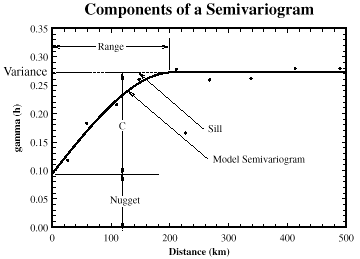
Traditionally, the semivariogram is presented as a graph: variance ( (h)) vs. distance. This graph represents the variation of sample values with distance. A set of semivariograms can be used to describe the sample variation with direction. An example model semivariogram is shown in
Figure 6-1 where the principal components are identified. The Sill is equal to the data set variance. For distances less than the Range, the estimate of (h) is less than the Sill (the data set variance). The Sill is composed of two components; the Nugget and C. The Nugget is the expected variance when two different samples are separated by a zero distance (to small to measure, or from a split sample). Normally one would expect this to be 0.0, but from a practical point of view, this is often is not the case. The term Nugget comes from the gold mining industry, and arises when a single sample is divided into multiple sub-samples for quality control analysis. The sub-samples are identified with the same location, thus have a zero separation distance. If the identical point could be re-sampled with no measurement error, the variation would actually be 0.0 (REF - Clark), but this reproducibility is not normally possible. Because gold often forms in nuggets of pure gold, it is possible that one sub- sample will have a high gold assay, and the remaining sub-samples will have little, or no gold. As a result, there can be significant variation over very small, or “zero,” distances and thus there is a non-zero variance (note: as the sample size increases, the variance decreases, because average values for larger volumes are less influenced by small scale variations). In evaluating field data, a nugget may exist because the sample spacing is not small enough to define the short-range features of the semivariogram. The remainder of the Sill, not defined by the Nugget, is defined by C. The nugget, C, and range are a function of the model equation used. There are restrictions on acceptable functions, mainly the result must yield a positive definite kriging matrices. With the Nugget, C, Range, and model equation type defined, the spatial statistics of the site are defined and the data can be kriged.
(h)) vs. distance. This graph represents the variation of sample values with distance. A set of semivariograms can be used to describe the sample variation with direction. An example model semivariogram is shown in
Figure 6-1 where the principal components are identified. The Sill is equal to the data set variance. For distances less than the Range, the estimate of (h) is less than the Sill (the data set variance). The Sill is composed of two components; the Nugget and C. The Nugget is the expected variance when two different samples are separated by a zero distance (to small to measure, or from a split sample). Normally one would expect this to be 0.0, but from a practical point of view, this is often is not the case. The term Nugget comes from the gold mining industry, and arises when a single sample is divided into multiple sub-samples for quality control analysis. The sub-samples are identified with the same location, thus have a zero separation distance. If the identical point could be re-sampled with no measurement error, the variation would actually be 0.0 (REF - Clark), but this reproducibility is not normally possible. Because gold often forms in nuggets of pure gold, it is possible that one sub- sample will have a high gold assay, and the remaining sub-samples will have little, or no gold. As a result, there can be significant variation over very small, or “zero,” distances and thus there is a non-zero variance (note: as the sample size increases, the variance decreases, because average values for larger volumes are less influenced by small scale variations). In evaluating field data, a nugget may exist because the sample spacing is not small enough to define the short-range features of the semivariogram. The remainder of the Sill, not defined by the Nugget, is defined by C. The nugget, C, and range are a function of the model equation used. There are restrictions on acceptable functions, mainly the result must yield a positive definite kriging matrices. With the Nugget, C, Range, and model equation type defined, the spatial statistics of the site are defined and the data can be kriged.
mention anisotropy at this point, or at least directional variation.
A number of steps are involved in fully defining the model semivariogram. The basic steps for developing an experimental and a model semivariogram are shown in the flowchart in Figure 6-2. The difference between the experimental semivariogram and the model semivariogram are:

|
|
|
|